



Remy in Action: How Generative & Agentic AI Are Transforming Modern Research
We explore how AI is changing the research landscape—and how Remesh is building toward a future where AI enhances, rather than replaces, human expertise.
Team Remesh
April 10, 2026
.png)

Artificial intelligence is no longer a future-state concept in research—it’s here, evolving rapidly, and fundamentally reshaping how insights are generated. But with that transformation comes both opportunity and responsibility.
In our recent webinar, Remy in Action: Generative & Agentic AI for Modern Research, we explored how AI is changing the research landscape—and how Remesh is building toward a future where AI enhances, rather than replaces, human expertise.
The Explosion of AI in Research
AI adoption in research isn’t just growing—it’s accelerating at an unprecedented pace.
Recent data shows that AI-related publications have nearly tripled over the past decade, reflecting widespread adoption across disciplines like engineering, life sciences, and beyond.
Why the surge? Because AI delivers on three critical dimensions researchers care about most:
- Scale: Analyze larger datasets than ever before
- Speed: Move from question to insight faster
- Validation: Challenge assumptions and strengthen findings
In practice, researchers are already using AI to summarize findings, generate ideas and interpretations, support writing and presentations, and assist with research design and analysis
But AI Comes With Real Risks
Despite its promise, AI introduces new challenges that researchers can’t ignore.
Bias remains one of the biggest concerns. AI systems are trained on human-generated data, and that means they can reflect (and sometimes amplify) human biases.
Researchers also cited risks such as:
- Overreliance on AI
- Loss of critical thinking
- Hallucinations and misinformation
- Reduced nuance in insights
The takeaway? AI is powerful—but it’s not infallible.
The Need for an Intentional AI Strategy
Successfully integrating AI into research requires more than adoption—it requires design.
A thoughtful approach includes:
- Verification: Validating AI outputs and workflows
- Examination: Understanding data sources and accuracy
- Cooperation: Building human-AI collaboration
- Transparency: Ensuring accountability and explainability
In other words, the future isn’t AI replacing researchers—it’s AI working with them.
Keeping Humans in the Loop
At Remesh, we’ve built our platform around a simple principle:
The researcher stays at the center.
AI supports every stage of the workflow, from designing discussion guides to moderating conversations and analyzing responses. But the human researcher remains the decision-maker—guiding, interpreting, and validating insights.
Meet Remy: Your Always-On Research Partner
This philosophy comes to life in Remy, Remesh’s embedded AI agent designed specifically for research.
Remy isn’t a generic chatbot—it’s purpose-built to act like a seasoned researcher.
It helps you:
- Build: Create discussion guides from simple prompts
- Ask: Get project guidance and explore your data
- Analyze: Surface themes, summaries, and key insights across studies
And critically, Remy provides:
- Grounded, defensible answers with citations tied to your data
- Cross-study analysis across multiple formats
- Operational efficiency, so you can focus on higher-value thinking
What Researchers Are Saying
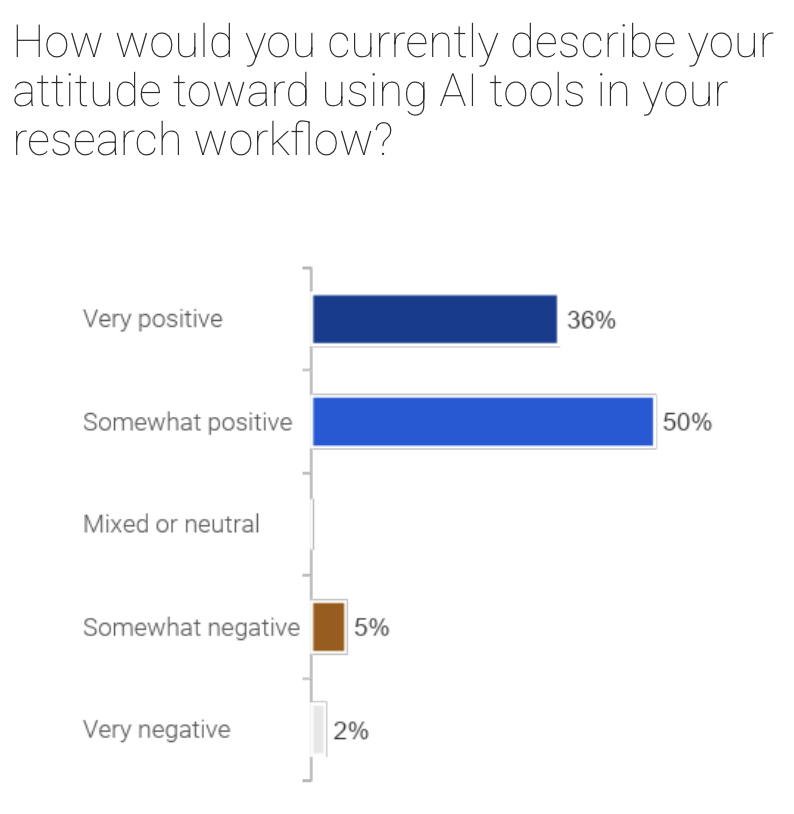
In a recent Remesh field study (March 2026), researchers shared a balanced but optimistic view of AI. Most report positive or somewhat positive attitudes toward AI with the top benefits including speed, efficiency, and insight generation. However, there were some concerns centered around bias, overreliance, and loss of rigor.
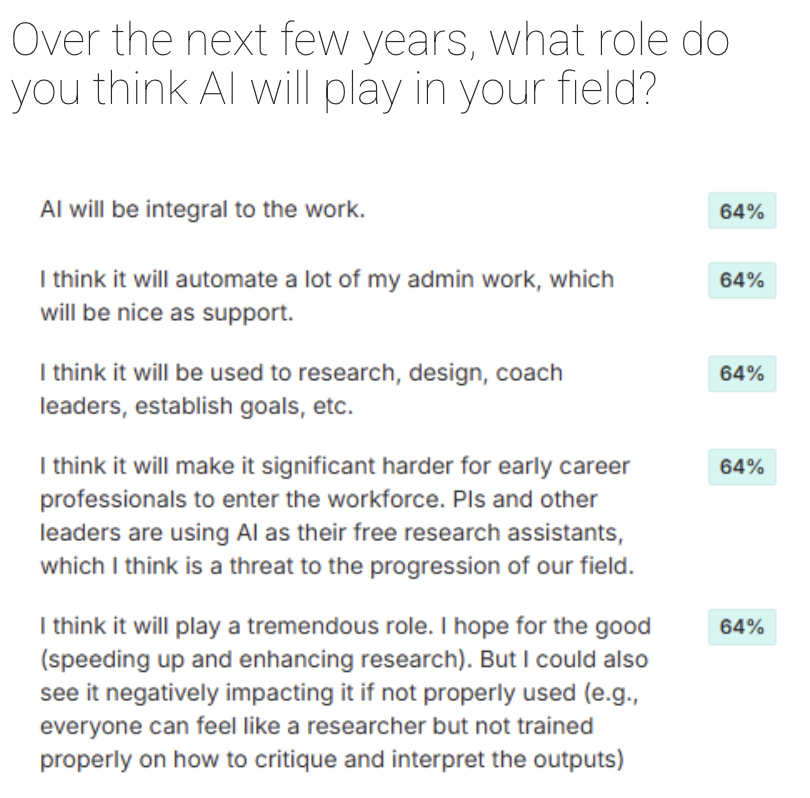
Interestingly, many researchers expect AI to become integral to their work in the coming years—while still requiring human oversight.
Building Confidence in AI
What would increase trust in AI for research?
Researchers pointed to (1) industry standards and guidelines, (2) independent validation of tools and (3) hands-on training and real-world examples.
This reinforces that trust in AI isn’t automatic, but earned through transparency, rigor, and education.
The Bottom Line: Augmentation, Not Replacement
The future of research isn’t AI vs. humans—it’s AI plus humans.
Organizations that succeed will treat AI as a support tool, not a substitute, invest in training and governance, and maintain human judgment and accountability
As one of the clearest conclusions from the study suggests, AI should improve efficiency without sacrificing rigor, fairness, or human insight.
Ready to See Remy in Action?
Remy represents a new category of AI—one that’s purpose-built for research, grounded in real data, and designed to keep humans in control.
If you’re exploring how to integrate AI into your research workflow, you can check out Remy for yourself with our simulation.
-
Lorem ipsum dolor sit amet, consectetur adipiscing elit. Suspendisse varius enim in eros elementum tristique. Duis cursus, mi quis viverra ornare, eros dolor interdum nulla, ut commodo diam libero vitae erat. Aenean faucibus nibh et justo cursus id rutrum lorem imperdiet. Nunc ut sem vitae risus tristique posuere.
-
Lorem ipsum dolor sit amet, consectetur adipiscing elit. Suspendisse varius enim in eros elementum tristique. Duis cursus, mi quis viverra ornare, eros dolor interdum nulla, ut commodo diam libero vitae erat. Aenean faucibus nibh et justo cursus id rutrum lorem imperdiet. Nunc ut sem vitae risus tristique posuere.
-
.png)
.png)
.png)


